
Icons on Ammo Boxes
St Leonard’s Chapel, St Andrews
27 October – 7 November 2025
In Autumn 2025 the Scottish university town of St Andrews hosted an exhibition titled Icons on Ammo Boxes. The exhibition was directed by the Chaplaincy of the University of St Andrews and the St Andrews Encyclopaedia of Theology. A project of the same name, by artists Sonya Atlantova and Oleksandr Klymenko from Kyiv, repurposes ammunition boxes – symbols of death – into sacred icons which represent life, offering an artistic response to the Ukrainian-Russian war.
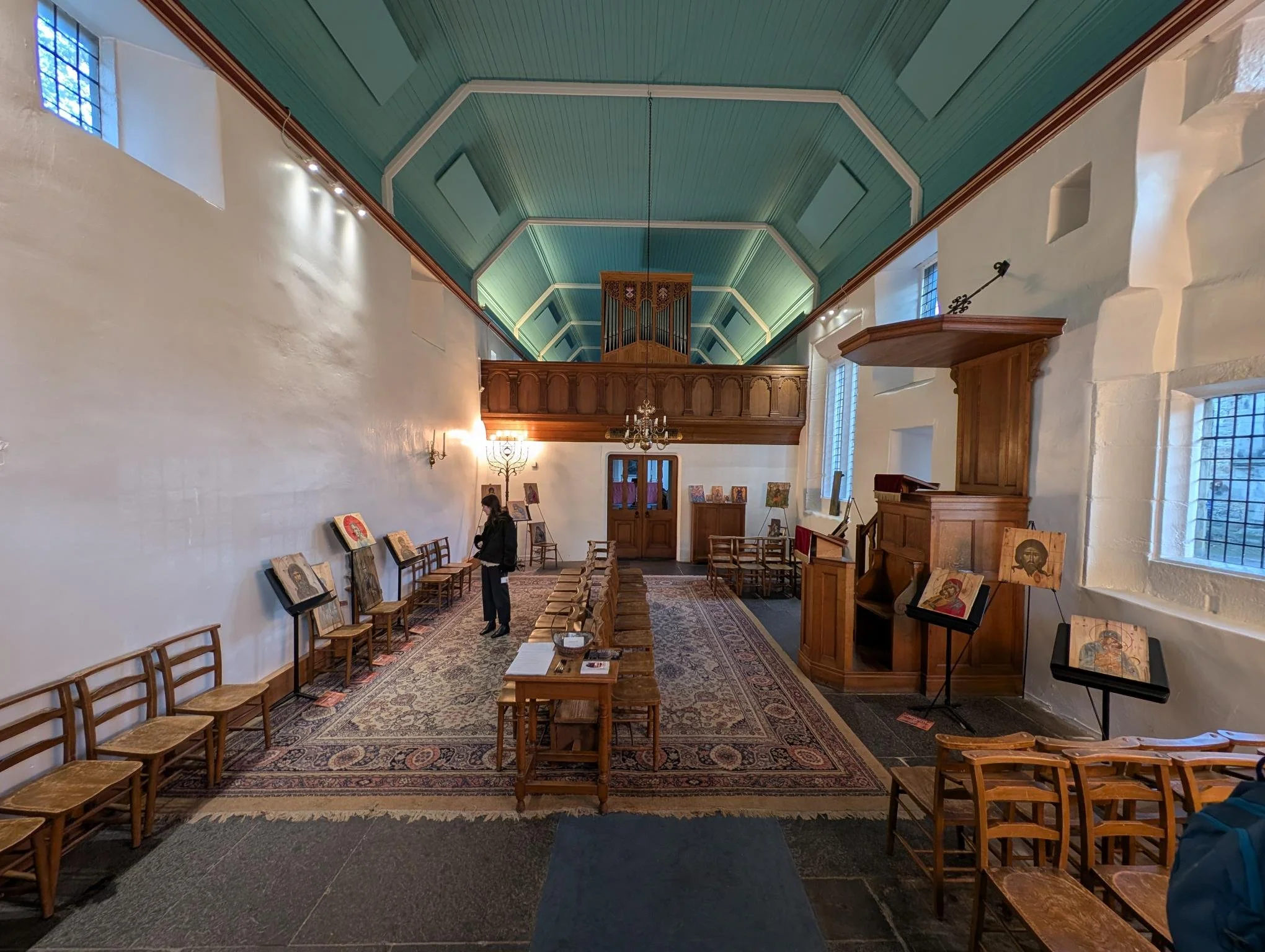
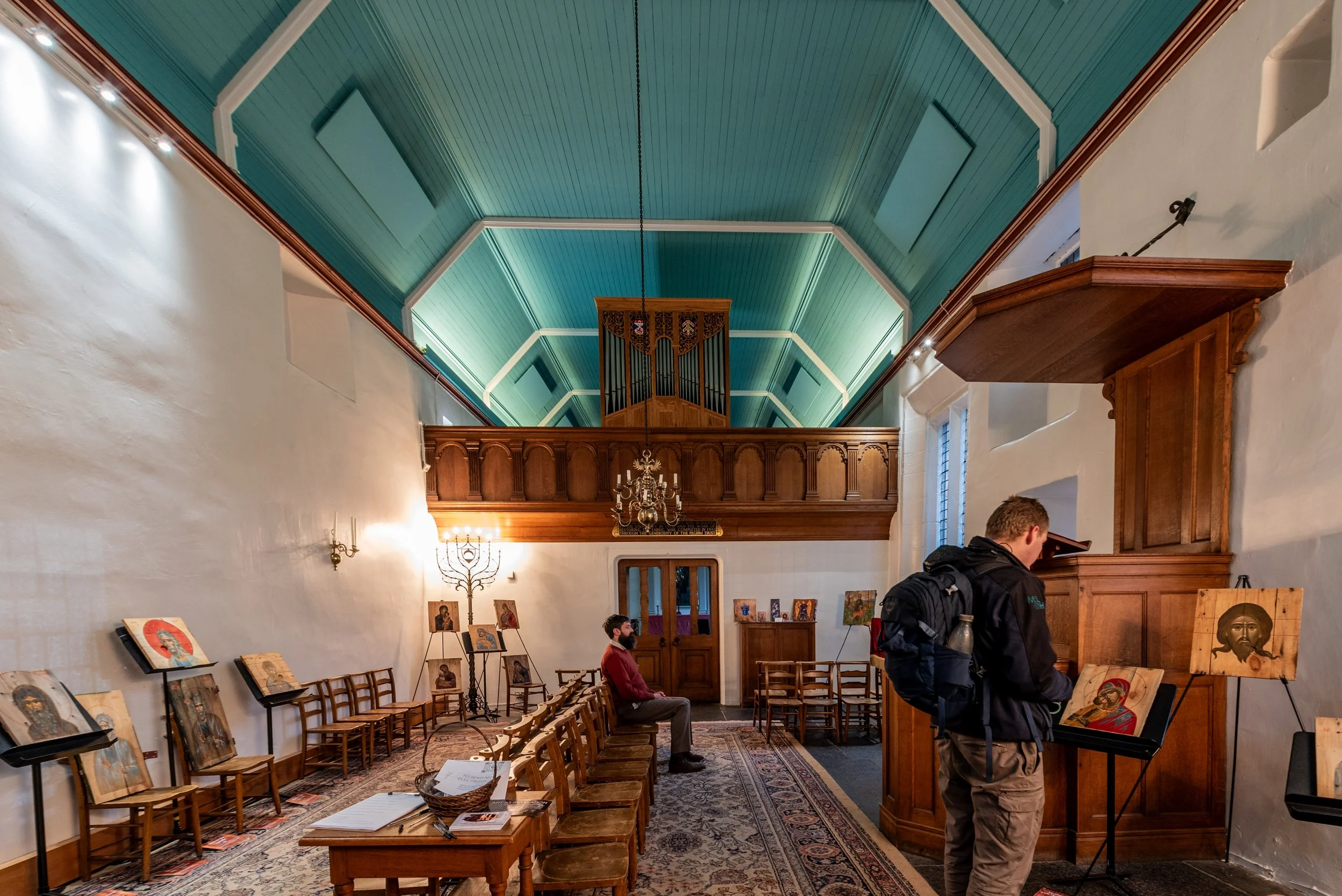
The icons, previously exhibited internationally – including Paris, New York, Brussels (in The European Parliament) and over 100 other cities – were displayed in the medieval St Leonard’s Chapel in St Andrews. The chapel fell into decay in the modern period but was refurbished and eventually rededicated in 1952. Today, the visitor finds a small chapel divided into a nave and a choir by a central screen with an organ loft above. The walls are limewashed and the ceiling painted blue, common in Scotland until the 17th Century.[1]
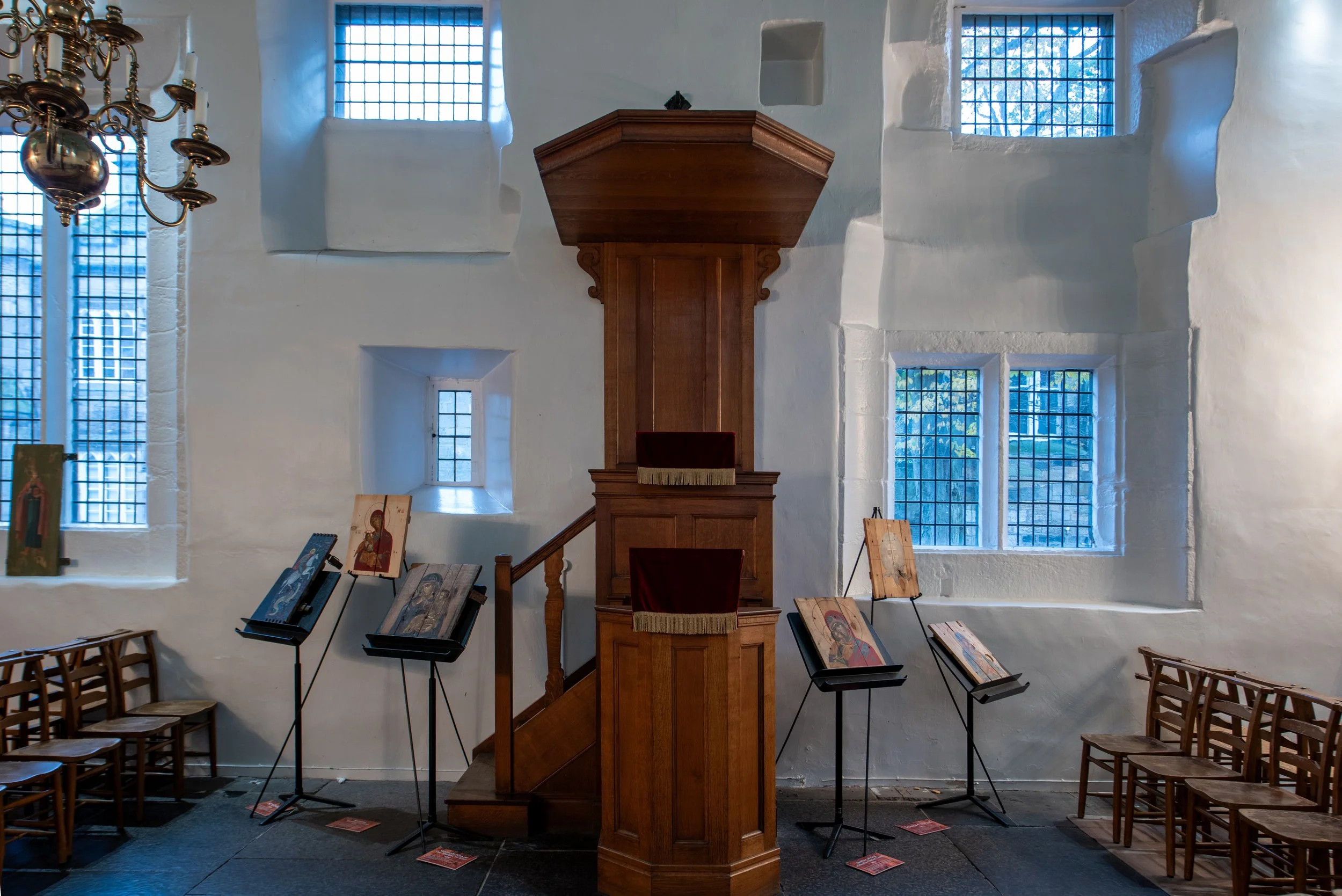
The 27 icons on display were found in the nave of the chapel, a rectangular space with two windows facing south, and shown in groups of three to five on various stands and wooden chairs, of which a few are also set up for the use of visitors. The autumn days this far north require nearly perpetual artificial lighting to make up for the lack of natural light, and the lights, along with the wooden pulpit protruding from between two groups of icons, are the only other elements in the room. The limewashed, stark walls only further heighten the austere atmosphere, serving as a perfect setting for the richly coloured icons.
This considered staging encourages a contemplative engagement with the icons. The quietness of the chapel slows the viewer down, entering into its stillness, and attending to the icons in a prayerful manner. The presence of chairs placed among the icons further reinforces this sense of reflection, blurring the boundary between exhibition and devotional space.
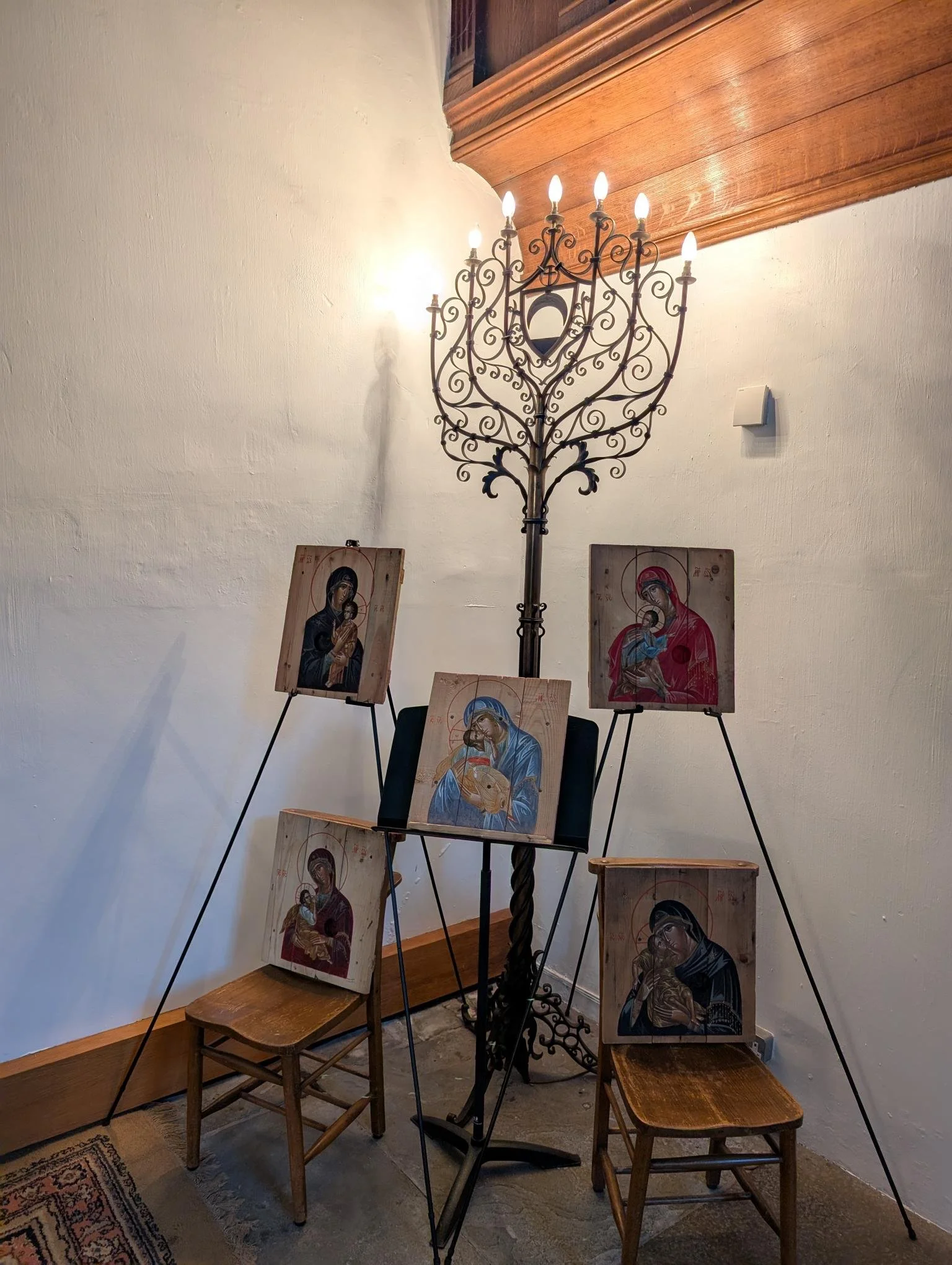
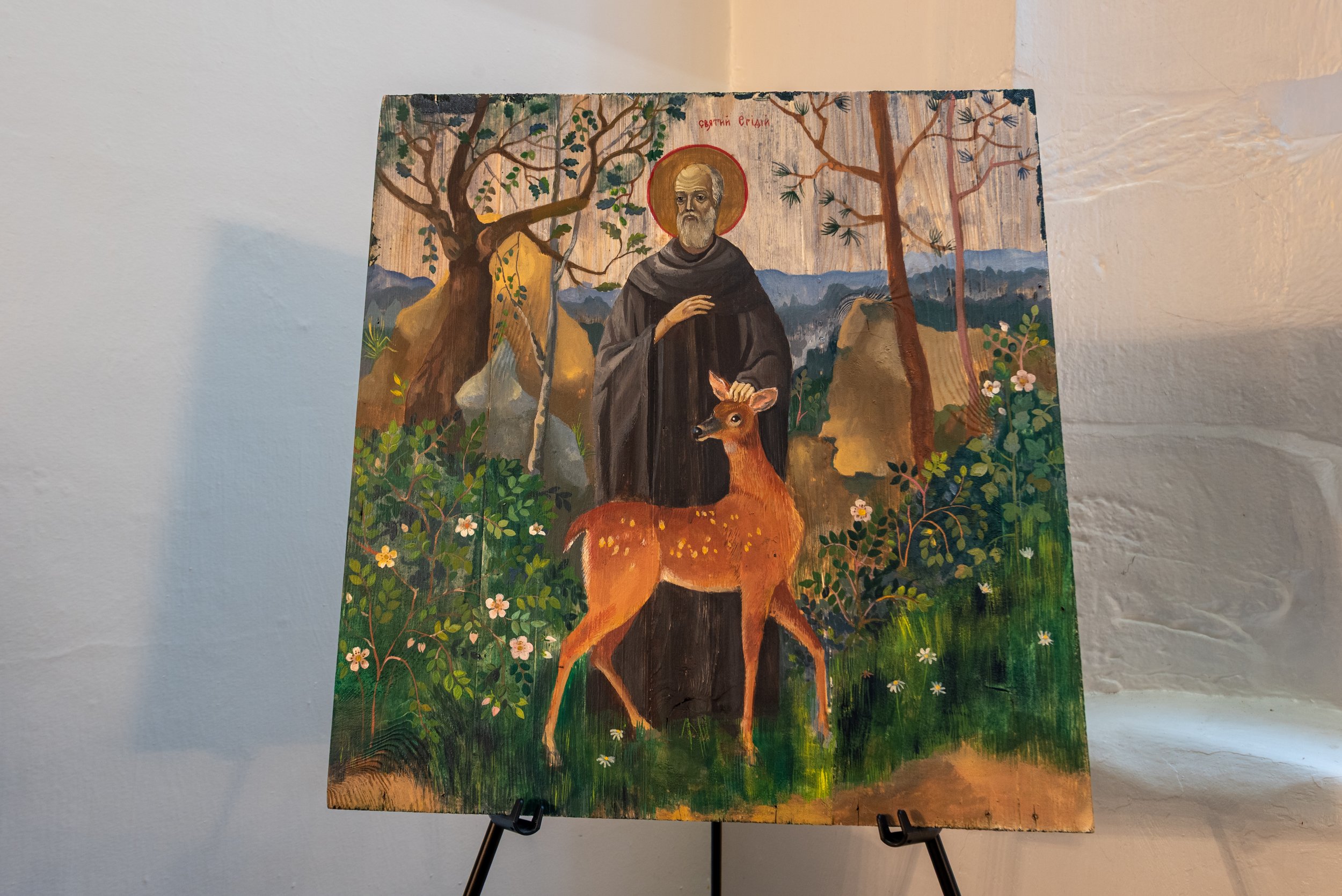
What then does the viewer contemplate? The most dominant part of the exhibition was a grouping of five Marian icons, wonderfully lit by a large lamp. An icon of the local saint Andrew was also of particular interest to the viewers, and paper copies of this icon, which were being sold alongside the exhibition, quickly sold out. These icons, like nearly all the icons in the exhibit, were painted in a traditional technique, with an instantly recognisable flatness of face. Icons are thus not meant to merely instruct, but the technical flatness of the portrait invites the viewer to pass through the two-dimensional image and establish a relationship to the depicted, historical figure.[2] Three of the most striking pieces were three modern icons, including one with St Giles with a deer. These are more in a Western illustrative style rather than the sparse flatness which distinguishes icons.
The unique feature of this exhibition is undoubtedly the ammo boxes which are used as the material base for the icons and shift it from merely a display of Eastern religious art to one with a more definite political message regarding the Russian-Ukrainian War. The effect of this can be quite jarring – on the one hand, the viewer can be enjoying a beautifully painted icon, only to step back and see the rough edges and nails of the ammo-box base. The message, however, is clear: war materials, in this case, ammo boxes, are turned into beautiful pieces of art, just as death turns to life. This closely follows the admonition in Isaiah 2:4 that ‘they shall beat their swords into ploughshares …’
The context of the Russian-Ukrainian war was present in more ways than one in this exhibition. At the very end of its duration, a delegation of Ukrainian officials, including several government ministers and contemporary Ukrainian artists, visited the exhibition. They were part of an initiative to unite the efforts of universities from around the world to develop Ukrainian studies. The visit further emphasises the context of these artworks in the Russian-Ukrainian War: Ukraine may be torn apart by war, but the education, culture and art of its people and country are prioritised regardless.
review by Maira Huisman
[1] https://www.st-andrews.ac.uk/about/historicon'sy/st-leonards/
[2] Hart, Aidan. 2024. 'The Theology of the Icon', St Andrews Encyclopaedia of Theology. Edited by Brendan N. Wolfe et al. https://www.saet.ac.uk/Christianity/TheologyoftheIcon