
Richard Harries: an obituary
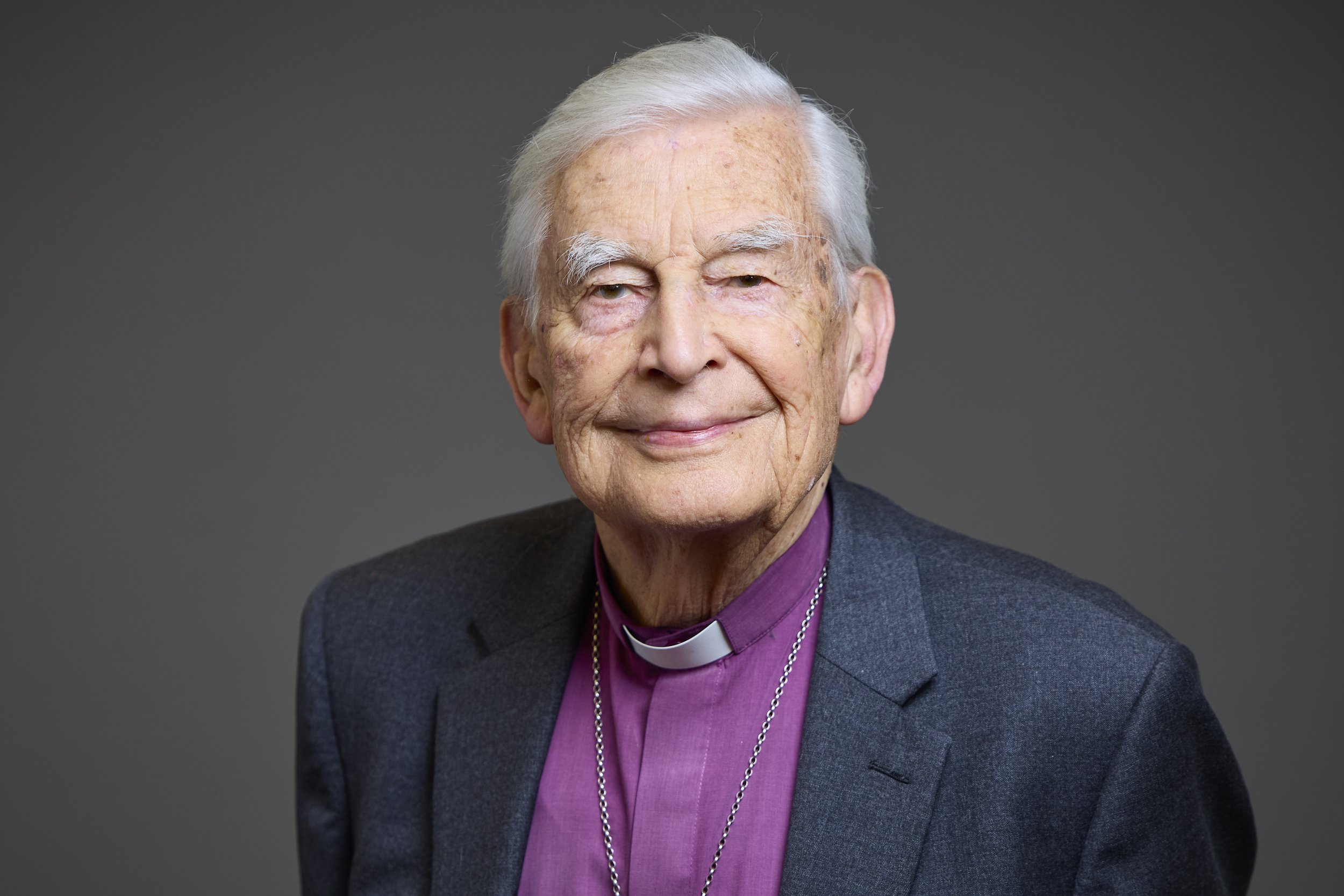
Richard Harries 1936 – 2026
The death of Bishop Richard Harries on the 29th April this year was marked by an unusually unanimous chorus of praise for his contributions to Church and society over many decades – not least his decades-long innings as a regular broadcaster, initially on ‘Prayer for the Day’ and then, after some rethinking at the BBC, on ‘Thought for the Day’, giving him the opportunity of speaking to millions of listeners in the context of a flagship morning news broadcast, whose listeners came from all over the globe. His last contribution was made very shortly before his death.
But alongside this, and alongside a lengthy and much appreciated ministry as Bishop of Oxford from 1987 to 2006 and Chair of the Church of England’s Board for Social Responsibility from 1996 to 2001, he produced an impressive array of books on a huge range of topics – bioethics, war and peace, interfaith issues, apologetics. And in his long and fruitful retirement, he combined regular involvement in the work of the House of Lords with a string of publications, increasingly centring on themes that had long been close to his heart to do with faith and the arts.
Others will assess his work as a moral theologian and defender of the faith in the public square. But it is as an explorer of the link between Christianity and the verbal and visual imagination that his work will be of most interest to readers of these pages. Anyone listening to him on the radio or in the pulpit will have been aware of his deep knowledge of the literary world: fiction and poetry informed his insights at every turn (unsurprisingly, he had a great enthusiasm for R S Thomas’s work as a poet of stark and honest evocations of faith’s struggle in an alien cultural environment). He published in 1993 a relatively brief but thoughtful and original book on Art and the Beauty of God; and in the decades that followed, he turned his attention increasingly to mediations on the visual arts, with substantial works on The Passion in Art (2004) and The Image of Christ in Modern Art (2013), as well as some briefer and more popular books of reflection on paintings of the life of Christ.
He showed himself in all these works to be a sensitive and richly informed commentator, always capable of finding fresh perspectives on images new and old, and his writing, like his broadcasting, connected with many well beyond the ecclesiastical sphere. As his 2008 book on The Re-enchantment of Morality argued, it was more and more important for Christians to understand that any persuasive moral vision had to work with the imagination, not only argument and will. In this, he stood close to a good many ethical theorists of recent decades who have advocated for an ethics concerned with the ‘form’ of a whole life, not simply a set of atomised decisions. An interest in the visual forms in which the new order of grace is represented is simply one necessary aspect of this approach to the moral life. And – as with his understanding of poetry – Richard’s engagement with the visual arts allowed him to go on insisting on the need to attend to moments of tension and irresolution in the life of faith and the perception of God. Throughout his writing, he was concerned, in one way or another, to disabuse his readers and hearers of the fantasy that there was somewhere an ideal state of stable, comprehensive vision: the experience of beauty is not a route out of the complex and compromised world we inhabit, but a light that picks out the realities we most need to ‘read’ so as to let them give some sort of shape to the environment we inhabit.
The book on The Image of Christ is a particularly remarkable achievement – at the simplest level, a really wide-ranging and fully documented survey of dozens of twentieth century painters and sculptors, lavishly illustrated, but also a compact history of trends in modern aesthetics overall. The extended discussions of Chagall, David Jones, and Roger Wagner in particular are full of insight, relating the visual work to a wide background in theology and poetics, while far less familiar figures like Albert Herbert are also given thoughtful and sympathetic treatment. It is a treasury of a book, and deserves all the praise it has received.
Richard’s lifelong engagement with the arts was, as I’ve said, only one strand in a unusually diverse tapestry of concerns. But it was a constant encouragement to all who recognise that the manifestation of faith in our generation has to maintain a sympathetic, hopeful and vulnerable relation with the world of human imagination. Richard Harries left many gifts to the Church, but this was not the least of them, and we may well be grateful for the intelligence and grace with which he explored this world.
Rowan Williams is a former Archibishop of Canterbury